
PPM Health Alert | Cyclospora Outbreak Expands: Beyond Fresh Produce, Here's What Consumers Need to Know

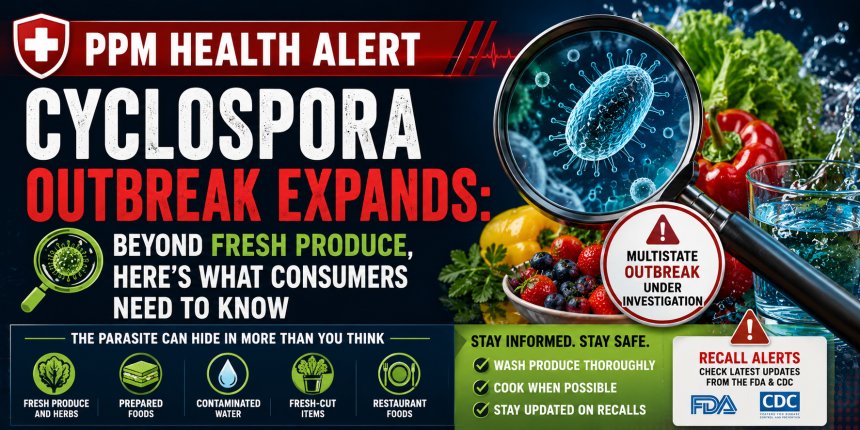
PPM Health Alert | Cyclospora Outbreak Expands: Beyond Fresh Produce, Here's What Consumers Need to Know
Category: Health & Wellness
Tags: Cyclospora, Cyclosporiasis, Food Safety, FDA, CDC, Public Health, Produce Recall, Consumer Safety
By Maya Brooks, Health & Wellness Writer
Editor's Note
A growing outbreak of cyclosporiasis, an intestinal illness caused by the parasite Cyclospora cayetanensis, has sickened thousands of people across the United States. While fresh produce remains the primary focus of the investigation, experts say the parasite can contaminate more than just fruits and vegetables depending on how food is grown, handled, or prepared. Health officials are continuing to trace the source.
What Is Cyclospora?
Cyclospora is a microscopic parasite that spreads when food or water becomes contaminated with human fecal matter containing the parasite. Unlike many foodborne bacteria, Cyclospora needs time in the environment before it becomes infectious, making direct person-to-person spread unlikely. Symptoms generally begin about one week after exposure and may include:
Severe watery diarrhea
Stomach cramps
Nausea
Fatigue
Bloating
Weight loss
Loss of appetite
Low-grade fever
Without treatment, symptoms can last for weeks or even return after temporarily improving.
It Isn't Just Fresh Produce
Fresh leafy greens and herbs remain the leading suspects because they are commonly eaten raw, but experts caution that any food handled after contamination can potentially become a vehicle for Cyclospora.
Foods under investigation or previously associated with outbreaks include:
Lettuce and salad greens
Bagged salads
Cilantro
Basil
Raspberries and blackberries
Snow peas
Fresh herbs
Fresh-cut fruit
Ready-to-eat deli salads
Foods prepared with contaminated produce
Because restaurants often use these ingredients in multiple menu items, investigators sometimes examine prepared foods in addition to the produce itself.
Are There Any Recalls?
At this time, there is no nationwide FDA recall for a specific brand, grower, or distributor of produce linked to the current multistate outbreak. Investigators continue working to identify the source.
Some businesses have voluntarily removed fresh ingredients as a precaution while public health officials investigate. For example, certain Taco Bell locations in affected regions temporarily stopped serving some fresh produce items, but this precaution does not represent a nationwide recall or proof that Taco Bell caused the outbreak.
Consumers should continue monitoring FDA and CDC recall announcements as the investigation evolves.
Why It's Difficult to Find the Source
Cyclospora outbreaks are among the hardest foodborne illnesses to investigate because:
Symptoms may not appear for about a week after exposure.
People often cannot remember every fresh food they ate.
Produce travels through complex supply chains before reaching grocery stores and restaurants.
Multiple products may come from the same farm or distributor.
These factors make identifying one contaminated source especially challenging.
How to Lower Your Risk
Experts recommend:
Wash fruits and vegetables under running water.
Wash your hands before preparing food.
Clean knives, cutting boards, and countertops.
Wash thick-skinned produce before peeling it.
Refrigerate fresh produce promptly.
Cook vegetables whenever possible, since heat kills the parasite.
It's important to note that washing reduces risk but may not completely remove Cyclospora, because the parasite is resistant to many chemical disinfectants. Cooking is the most reliable way to destroy it.
Current Outbreak Update
As of July 19, 2026, the nationwide Cyclospora outbreak remains one of the largest ever documented in the United States. Federal health officials continue to report at least 1,645 laboratory-confirmed U.S.-acquired cases across 34 states, while more than 5,100 additional illnesses remain under investigation. At least 141 hospitalizations have been reported, and no deaths have been confirmed. The FDA and CDC are continuing traceback investigations, with shredded iceberg lettuce identified as a focus of one multistate investigation and a major voluntary recall expanding to multiple brands and states. Officials caution that the true number of illnesses is likely higher because many people recover without seeking medical care or testing.
PPM Takeaway
Cyclospora remains an active public health investigation. While fresh produce is still the leading focus, contamination can extend to prepared foods that contain raw produce. At this time, there is no confirmed nationwide recall tied to a specific brand or supplier, and health officials continue to urge consumers to practice safe food handling rather than avoid fruits and vegetables altogether.
As investigators gather more evidence, additional recalls or public health advisories could be issued.
PPM Health Update | Cyclospora and Recreational Water: What Parents Need to Know
As the nationwide Cyclospora outbreak continues, many parents are asking whether swimming pools, splash pads, and water parks pose a risk to their children.
The short answer: The current U.S. Cyclospora outbreak is primarily being investigated as a foodborne outbreak—not a recreational water outbreak.
What Is Cyclospora?
Cyclospora (Cyclospora cayetanensis) is a microscopic parasite that causes an intestinal illness known as cyclosporiasis. People become infected after swallowing food or water contaminated with the parasite.
Most U.S. outbreaks have been linked to contaminated fresh produce, including leafy greens, herbs, berries, and other foods eaten raw. Federal investigators continue to trace the source of the current multistate outbreak.
Are Pools and Splash Pads a Risk?
Cyclospora can spread through contaminated water, but public swimming pools and splash pads have not been identified as the source of the current nationwide outbreak.
Parents should also know that Cyclospora is often confused with Cryptosporidium ("Crypto"), another intestinal parasite.
Cryptosporidium—not Cyclospora—is the parasite most commonly associated with outbreaks linked to public pools, splash pads, and water parks because it is highly resistant to normal chlorine levels used in recreational water.
Although swallowing any contaminated recreational water should be avoided, the current Cyclospora investigation remains focused primarily on contaminated food.
Symptoms to Watch For
Symptoms usually develop about one week after exposure, although they may appear anywhere from 2 days to 2 weeks later.
Common symptoms include:
- Frequent watery diarrhea
- Stomach cramps
- Nausea
- Bloating
- Fatigue
- Loss of appetite
- Weight loss
- Low-grade fever
Without treatment, symptoms can last several weeks or temporarily improve before returning.
When Should Parents Call a Doctor?
Seek medical advice if your child has:
- Persistent watery diarrhea
- Signs of dehydration
- Difficulty drinking fluids
- Severe stomach pain
- Symptoms lasting several days
Doctors can diagnose Cyclospora through specialized stool testing. When appropriate, the recommended treatment is the prescription antibiotic trimethoprim-sulfamethoxazole (TMP-SMX).
How Families Can Stay Safe
Whether visiting a neighborhood pool, splash pad, lake, or water park, experts recommend:
- Do not swallow recreational water.
- Keep children out of pools if they have diarrhea.
- Wash hands with soap and water before eating and after using the restroom.
- Wash fresh fruits and vegetables thoroughly before eating.
- Stay informed about FDA and CDC food safety alerts and recalls.
PPM Takeaway
The current Cyclospora outbreak remains under active investigation, with evidence continuing to point primarily toward contaminated food rather than public swimming facilities.
Families should continue enjoying summer activities while practicing good food safety and recreational water hygiene. Preventing children from swallowing pool water, encouraging proper handwashing, and monitoring for persistent gastrointestinal symptoms remain practical ways to reduce the risk of many foodborne and waterborne illnesses.
Original Reporting Credits
This article was developed by Power Pulse Magazine using reporting and health guidance from Nationwide Children's Hospital, the American Academy of Pediatrics, Johns Hopkins Medicine, and the Centers for Disease Control and Prevention (CDC). Additional reporting and editorial analysis by Power Pulse Magazine.This version accurately separates Cyclospora from Cryptosporidium, avoids overstating the role of pools in the current outbreak, and reflects current CDC guidance.
- CDC
https://www.cdc.gov/han/php/notices/han00531.html
- Yahoo Health
- Arizona News
- Democrat and Chronicle
"Cyclosporiasis: Where the Cyclospora parasite can hide besides produce" (July 15, 2026).
Additional reporting, fact-checking, and editorial analysis by Power Pulse Magazine, with information verified through the U.S. Centers for Disease Control and Prevention (CDC) and current public health reporting.
PPM Disclaimer:
This article is for informational purposes only and is not medical advice. Information was researched using publicly available health guidance and verified reporting. AI-assisted research supported the editorial process, and all content was reviewed and edited by a human editor. Creative direction by Power Pulse Magazine.
Share
What's Your Reaction?
 Like
0
Like
0
 Dislike
0
Dislike
0
 Love
0
Love
0
 Funny
0
Funny
0
 Angry
0
Angry
0
 Sad
0
Sad
0
 Wow
0
Wow
0